Search This Blog

Friday, June 21, 2019

Colonel Sanders from Kentucky

Not the pretend colonel who founded the fried chicken chain, but William P. Sanders, a Kentucky-born West Pointer who on this date in 1863 was leading a successful raid in the vicinity of Knoxville, Tennessee, having advanced south from Kentucky under orders from Major-General Ambrose Burnside. He would turn 30 in August.
Sanders had served in the Peninsula Campaign and at Antietam before moving west. He helped Burnside capture Knoxville in early September, 1863, and defend it against Confederate General James Longstreet's advance in November. Sanders was actually serving as a brigadier general when he was mortally wounded on Nov. 18, dying the next day. The US Senate had not yet confirmed his promotion. Fort Loudon was renamed Fort Sanders in his honor, and it successfully held off Longstreet's assault on Nov. 29.
The Knoxville campaign influenced major events to its southwest, helping the Army of the Cumberland recover from its defeat at Chickamauga and win the Battle of Chattanooga.

Tuesday, June 18, 2019

Schumer at Grant Cottage

It's obviously good news that Grant Cottage (in Saratoga County, NY) was visited yesterday by one of the most influential politicians in the country, New York Senator and US Senate Minority Leader Chuck Schumer. He pledged to press for the site's designation as a National Historic Landmark, making it potentially eligible for federal funding.
The cottage is facing challenges, especially regarding security, in the wake of the closure four years ago of the state prison which used to occupy the top of Mount McGregor. People like Schumer, and Gov. Andrew Cuomo, can help it meet those challenges. 
As I have long thought, the best long-term solution is to renovate the upstairs (never part of public tours) and bring back live-in caretakers. For most of the cottage's history, caretakers lived upstairs, and bringing them back was too briefly discussed when the prison closure was announced.
A new, full-time caretaker, with housing as part of their salary, is the way to keep the cottage safe now and into the future, in the grand tradition of Oliver Clarke and Suye Narita Gambino
For more on the latter, and her nephew Kenjiro Yoshida who served with the US Army and was killed in action in Europe during World War II, come to the July 7 talk by Steve Trimm. Steve, who wrote the small book I link to above (which is for sale in the Visitor Center), is also an expert on the history of Oliver and Martha Clarke.

Monday, June 17, 2019

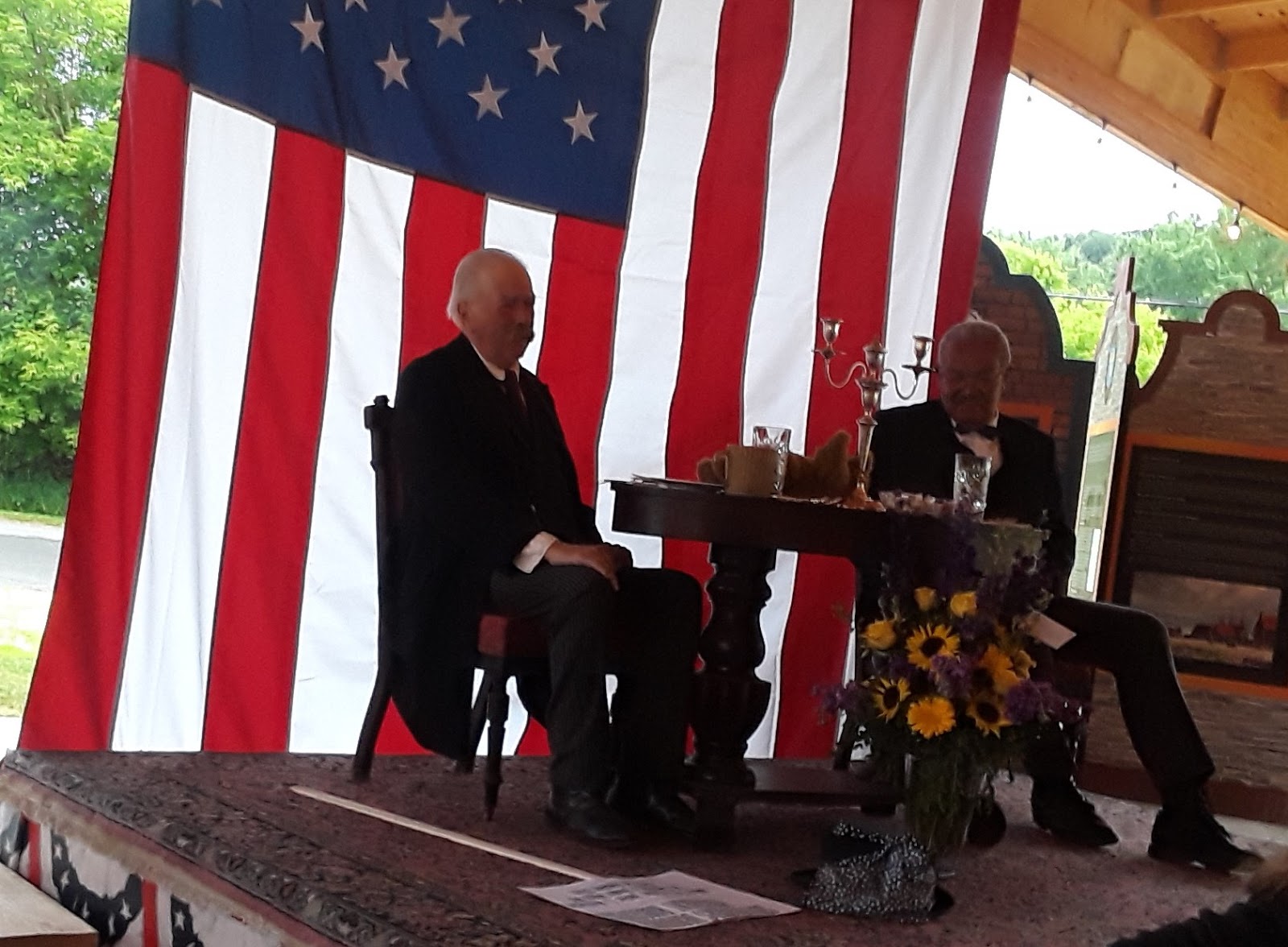
T Roosevelt and BT Washington

Theodore Roosevelt and Booker T. Washington, as portrayed by Paul Stillman and Clifford Oliver, on stage Saturday at the new pavilion next to the Knickerbocker Mansion, in Schaghticoke, Rensselaer County, NY. (If any uncertain spellers live in that vicinity, do they give up writing in despair? Even if they get the locations right, there's still the question of Knickerbocker of Knickerbacker.)
The short play has the ex-president and the civil rights leader (who founded the Tuskegee Institute) speechifying and reminiscing about their controversial White House dinner meeting of 1901, and the state of race relations in the first term of pro-segregation President Woodrow Wilson.
Washington's career was jump-started in the 1870s by the former Civil War soldier Samuel C. Armstrong. Roosevelt was the first president since the Civil War to have been too young to fight in it, but made his name soldiering in Cuba. His "splendid little war" description of that conflict may grate to modern ears, but, like Henry Kissinger, he wound up with a Nobel Peace Prize.

Thursday, June 6, 2019

Judah Benjamin


Judah Benjamin was "called to the bar" in London on today's date in 1866, when he was in his mid-50s, and went on to a dazzlingly successful legal career there. (He is pictured above a few years earlier, on the Confederate two-dollar bill.)
Benjamin had risen from humble origins in Charleston, SC, and New Orleans to become a US senator, until he resigned in his second term when Louisiana seceded. A close ally of Jefferson Davis, he served the Confederacy as attorney general and secretary of war, then from 1862 to 1865 as secretary of state. Whether in the USA, the Confederacy or the United Kingdom, he had to overcome anti-Semitic prejudice.
While Benjamin was among those Confederates toward the end of the war who were prepared to recruit slaves for the Army and promise them freedom, he was also a determined defender of slavery, and after the war (in correspondence) an opponent of black political rights and critic of Reconstruction.

It was fortunate for the Union cause that his counterpart as US secretary of state was the equally brilliant and even more effective William H. Seward.

Monday, May 27, 2019

Memorial Day and Port Hudson (updated)

Varicose veins kept my father out of the US Navy, and for most of his life he would have denied serving in the military at all. Eventually, however, the government decided otherwise, which is why today his grave with that of my dear stepmother can be found in Saratoga (NY) National Cemetery. He was never in combat, and would have thought it preposterous to brag about his role in the war, well aware as everyone was of the sacrifice borne by so many. He hadn't met his first wife yet, and never saw her brother, my 19-year-old uncle Joe Gaffney, who was killed fighting with Third Army in the Ardennes.
My father just went to work for Pan American World Airways, staying with them for the rest of his career until, as the company was spiraling into dissolution, it laid him off in the early 1980s. In World War II, as the government eventually decided, that meant he was attached to 
Air Transport Command of the United States Army Air Force. He served on military transport planes (Douglas C-54s, I believe) with regular routes from Newfoundland or Bermuda through a base in the Azores to Casablanca, North Africa.
He must have heard have heard the joke about another mid-Atlantic base,
"If I don't hit Ascension,
My wife will get a pension."
He was the navigator, and 22 years old.

We walked around the cemetery a little, the wife leaving lilacs for some of those lost in our 21st century wars, and at the marker of an unknown New York soldier who was killed in 1862 at the Battle of Antietam.

From there we went to my sister-in-law Ruth Ann's grave at Greenridge Cemetery in Saratoga Springs, where also can be found Civil War soldiers.
That grand monument is all very well, but some of the graves tell a grim story. This lieutenant, for example, was killed at Fort Stedman (or Steadman, as the tombstone spells it) on March 25, 1865, defending against Robert E. Lee's last offensive. The war almost over, yet he had to die.
This soldier died in 1862 at Camp Griffin, Va., probably from disease.
On today's date in 1863, the first of two unsuccessful assaults was made against the Confederate fortress of Port Hudson in Louisiana on the Mississippi River. The Union commander was Nathaniel Banks, who had succeeded Benjamin Butler. Both were political generals who never learned military competence and were retained too long. According to Wikipedia, the Union had casualties of about 5,000 killed or wounded during the one-and-a-half-month siege, but another 5,000 men died of disease. The deaths of most Civil War soldiers came from disease, not combat.
Grant was taking unnecessary casualties about the same time as Banks, directing unsuccessful assaults on Vicksburg, up the river; and Rear Admiral David Farragut lost ships and men running by Port Hudson in March. But Grant and Farragut could fight their way through to victory, whereas Banks and Butler generally produced defeat. Yet Port Hudson did fall, eventually.
One of Banks' subordinate generals, Thomas Sherman, lost a leg in the May 27 attack there. By his side was Captain Adam Badeau, who was shot in the foot. A writer before and after the war, who also became an undiplomatic diplomat, Badeau spent his military career as a staff officer. Twenty-two years later, he would play a key but unheroic role in The Last Circle of Ulysses Grant.


Wednesday, May 22, 2019

Postwar Border War

While the May 12-13 (1865) Battle of Palmito Ranch in Texas -- a Confederate victory -- is often called the last battle of the Civil War, homicidal violence plagued much of the South during Reconstruction and beyond, typically targeting freed slaves who sought to exercise their new civil rights.
Even the border states of Missouri and Kentucky proved hard to pacify. In Missouri, especially, as the famous career of Jesse James demonstrates, Confederate bushwhackers moved seamlessly into banditry, continuing to muddy the divides between war, peace and murder as they had been muddied by both sides since 1850s "Bleeding Kansas."
On today's date in 1865, not far south of St. Louis, US troops killed a man in a gang of store robbers led by bushwhacker Sam Hildebrand, who had a grim war record, and would continue his violent career until he was killed in 1872 in southern Illinois.

Monday, May 20, 2019

Col. William A. Phillips

Phillips was an abolitionist activist in Kansas before the war -- like another obscure Civil War colonel, James Montgomery, whose biography I now happen to be writing. Somebody should write a book about Phillips, too. His careers included work as a journalist and a postwar member of Congress. He also served as a lawyer for the Cherokees after the war, and during it they made up most of his Indian Brigade. Those soldiers under his command deserve most of the credit for capturing and holding the Indian Territory for the Union, in the face of great logistical and other difficulties.
On today's date in 1863, for example, Phillips was fending off a Confederate attack near Fort Gibson. And he wound up dying at Fort Gibson in 1893, while conducting business for the Cherokees.

How Newspaper Journalism Shaped "The Detective and Dorothy Day"

  The guy in the middle hosts an annual picnic in the park at this time of year, where we three friends often meet up, and did yesterday. We...