Search This Blog

Wednesday, October 31, 2018

Upcoming Events

I'll be at the Chronicle Book Fair this Sunday, Nov. 4, from 11 to 3 at the Queensbury Hotel in downtown Glens Falls. I'll be doing a five-minute reading between 1 and 1:30 (if no kids are around, I'm thinking a WT Sherman-Mary Audenried sex scene from the novel), then will be on a panel discussion from 2 to 3. I will also have discounted books for sale, both the 2018 novel The Last Circle of Ulysses Grant, and the 2013 biography of Civil War General Gordon Granger.
Then on Wednesday, November 14, I'll be in the great city of Albany, at Swifty's Pub on Everett Road, to talk to Da Buffs. That's a Civil War  dinner and discussion club (Barb and I are members). But you too can turn up at 6:30 and order off the menu (try the reuben spring rolls), then check out my new and improved talk and PowerPoint on the Grant book like the one I did in Saratoga Springs (see picture above) earlier this year. Books for sale at the Swifty's event, too, at the same price as at the book fair.

Monday, October 29, 2018

Uncomfortable Indian War Connections to Price's Raid

On this date in 1864, Sterling Price's Confederate army was camped five miles south of Pineville, Missouri, near the Arkansas line, over which it would retreat the next day before heading to Indian Territory. The soldiers and guerrillas in his force would not return to Missouri until the war was over.
Price had risen to fame in the Mexican War, during which he ruthlessly suppressed the Taos Revolt against Indian and Hispanic forces.
His Union opponents in the Civil War had later connections to the Indian wars. US Major General Samuel Curtis was victor of the Battle of Westport (today a pleasant part of Kansas City) against Price on Oct. 23, 1864. Curtis also has some responsibility for the Sand Creek Massacre of Indians in Colorado the next month (even though he wasn't there), due to his harsh orders to a subordinate, Col. John Chivington, who bears primary blame. 
In early 1862, Curtis had defeated a Confederate army including Price and an Indian cavalry force at the Battle of Pea Ridge in Arkansas, and Chivington played a key role in defeating the Confederate invasion of New Mexico at the Battle of Glorieta Pass. 
Curtis' chief subordinate in the 1864 campaign against Price, James Blunt, was accused of corruption in his dealings with Indians after the war. In 1863, Curtis' son Zarah was killed when serving under Blunt, by Quantrill's Confederate guerrilla raiders. In 1862, Blunt was fighting alongside Frank Herron, a major character in The Last Circle of Ulysses Grant.
US Major General Alfred Pleasonton's cavalry (dispatched by Rosecrans) was harrying Price from the rear at Westport, and he was then in independent command at the Battle of Mine Creek as the Confederates retreated south. In both of these Union victories, Pleasonton's subordinate Lt. Col. Frederick Benteen played a key role. 
Pleasonton had served earlier in the Army of the Potomac. It seems to me his record there is unduly criticized, but one move he made which undoubtedly worked out well was the June 29, 1863, promotion of George Armstrong Custer from captain to brigadier general. This was just before the Battle of Gettysburg, in which, as in subsequent Army of the Potomac battles, the new young general would play a major and positive role.
 After the Civil War, though, as colonel of the 7th Cavalry, Custer's record was much less stellar. Some blamed (and still blame) Benteen for failing to rescue him in 1876 at the Battle of Little Bighorn, but I don't think the criticism justified.  

Wednesday, October 17, 2018

Clio and Rice Bull

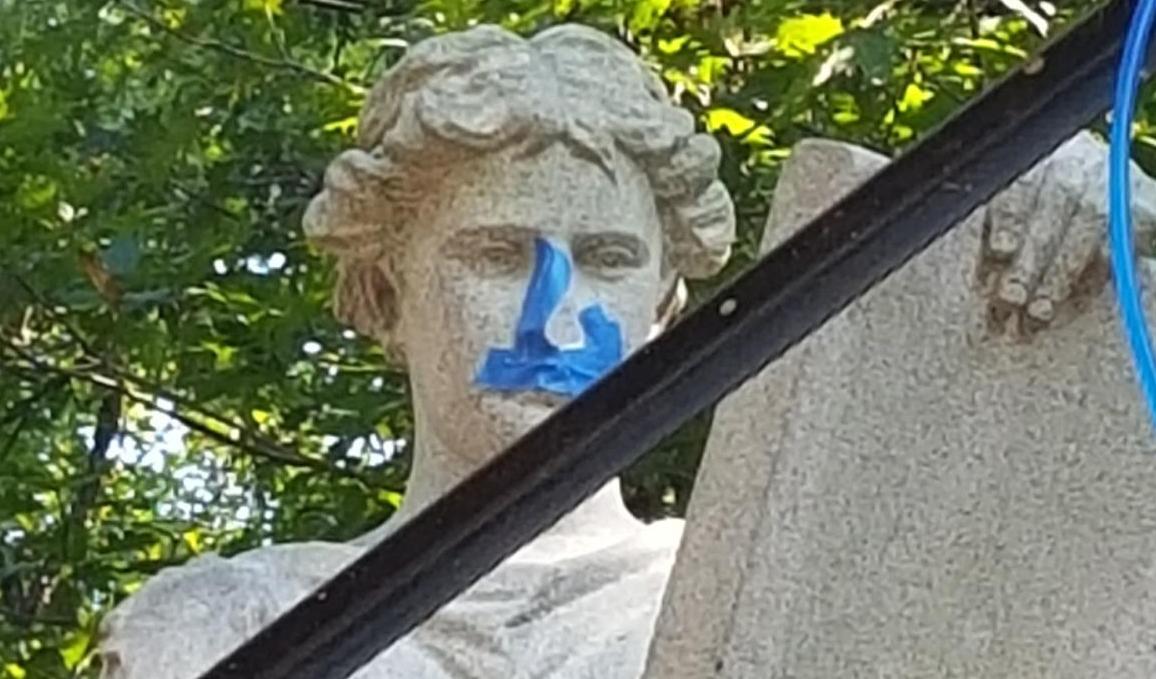
The Glens Falls Post-Star reports that the only statue depicting a female on the Gettysburg battlefield got a "nose job" repair last month. Clio, on Culp's Hill, represents the muse of history and the 123rd New York Volunteer Infantry, whose recruits came from Washington County. 
Among them was Rice Bull, whose book I keep meaning to read. He is buried in Oakwood Cemetery, north Troy, along with other Civil War soldiers including his sometime commander, the Rock of Chickamauga.


Tuesday, October 9, 2018

Fiction, History and Shelby Foote

Shelby Foote was a novelist before he was a historian, and at least one of those novels, Shiloh, was about the Civil War. Then he wrote the classic three-volume Narrative history of the war, and was the key talking head in Ken Burns' excellent PBS documentary.
A Facebook group I belong to, The Civil War Buff (as opposed to Da Buffs, an Albany, NY, dinner group to which I will make a presentation and try to sell books on Nov. 14), has been discussing Foote. While I think Foote's lack of footnotes is a legitimate issue for critics to raise, as well as, to a lesser extent, his inclination toward the Confederate side of the conflict, I still defend him as one of the war's great historians. He wrote well, with a vivid and accurate sense of the great drama of those events, while rigorously pursuing the truth as he saw it.
While most people on the Facebook thread were admirers of Foote, others said fiction "overlapped" into the history, or compared him unfavorably to another historian who "has a PhD and taught history at the University of Virginia. Shelby Foote wrote books."
I said this: "Shelby Foote's imagination made him a better historian. Not because he made it up, but because, as David McCullough pointed out, a historian needs to imagine what life was like for the people he writes about. He needs to get inside their heads."
And there are limits to biography.

Thursday, October 4, 2018

Hold the Fort

The Presbyterian hymn by Philip Bliss inspired the labor union song, which in my Newspaper Guild days I heard Joe Glazer sing at the former AFL-CIO campus in Silver Spring, Maryland, and myself sang to my children at home.
Bliss was inspired by a garbled version of a message dispatched from the not notably religious or labor-friendly William Tecumseh Sherman to Brigadier General John Corse in Allatoona, Georgia. 
On today's date 154 years ago, Sherman dispatched Corse to defend Allatoona and Confederate Lt. Gen. John Bell Hood sent Major General Samuel French to attack and capture the same place. The fighting commenced the next morning, Oct. 5, after Corse declined to surrender.
Allatoona was a supply depot on the rail line from Chattanooga, Tennessee, to Sherman's army in Atlanta.
Corse's outnumbered Union men won a defensive battle, which may have encouraged Grant to let Sherman march to the sea. And Hood eventually continued on his way to Tennessee, where his army was crushed by Union victories south of Nashville in November and December.

Sunday, September 30, 2018

Guns, Cotton and Grant

The NRA's August 29 American Rifleman magazine (sent to me by a friend) has an interesting article by S.P. Fjestad titled General Grant's Magnificent Set of Lost Remingtons.
It is a tale of the murky Civil War world of cotton trading along the Mississippi river, which the US government couldn't decide whether to ban or encourage. Grant certainly had difficulties in this political minefield, and when it also touched on his occasionally volatile relations with his father, the result was the genuine scandal of the Dec. 17, 1862, anti-Semitic order -- much regretted by Grant. That blunder, however, is not what the Rifleman story is about. Rather, it's about how a pair of personalized pistols given to Grant by a wartime cotton trader have turned up on the open market. While the guns were a nice gift, and the cotton trader (O.N. Cutler) was no doubt glad to get the cooperation of US military authorities (Grant's subordinate Gen. James McPherson also got a pair), there is one major flaw in the story, reflecting an outdated tendency to ascribe bad motives and actions (in this case corruption) to Grant (and here McPherson) without any evidence.
Fjestad writes: "After Confederate control of the Mississippi ended during mid-1863, cotton shipments to the East Coast became both more frequent and reliable thanks to the Union’s 'delivery protection service,' but only if the right people were involved. A 50/50 profit-sharing arrangement between the Union and cotton suppliers was the norm for these contracts. This lucrative arrangement generated massive amounts of revenue for both the Union and Cutler/Wagley, and no doubt, Generals McPherson and Grant."
That phrase "no doubt" in the last sentence is doing a lot of work, attempting to distract from the fact that the story offers absolutely no evidence that Grant or McPherson profited in any way, apart from getting the pistols. And while Grant can be criticized, in his later career, for accepting gifts such as houses from admirers, I have seen no evidence that he ever accepted bribes to do anything, and the fact that he died heavily in debt may be adduced to the contrary.

Tuesday, September 25, 2018

Forrest and Thomas

On today's date in 1864, Confederate Major General Nathan Bedford Forrest's cavalry won the Battle of Sulphur Trestle, the day after their victory at Athens, Alabama. The next month Forrest launched a long northward raid into Tennessee, winding up in early November with a highly successful attack on Johnsonville, west of the Union base at Nashville. This latter coup prompted Sherman's famous rant about how "that devil Forrest must be hunted down and killed if it costs ten thousand lives and bankrupts the federal treasury."
Major General George Thomas, in command at Nashville, sent John Schofield with a couple of brigades to Johnsonville in response. A month later, John Bell Hood's army was encamped south of Nashville, and he detached Forrest to Murfreesboro (as Bragg and Davis in 1863 had detached Longstreet to Knoxville). At the Third Battle of Murfreesboro on Dec. 5, the Confederates were bested by Union forces including a brigade under the ubiquitous Vladimir Krzyzanowski (a recurring character in The Last Circle of Ulysses Grant).
 Later in December, after Thomas' crushingly effective offensive at Nashville, Forrest ran an effective rearguard campaign for Hood's retreating army as it left Tennessee forever. He was appointed lieutenant general the next year, a higher rank than Thomas ever achieved, burnishing his legend (or, from another perspective, his notoriety). But Forrest had much less influence on the war than the Union-loyal Virginian who was in command of US forces in that Tennessee campaign. 

Albany Times Union Reviews 'The Detective and Dorothy Day'

  Thanks to Jack Rightymer for a positive review of The Detective and Dorothy Day   in the middle of a round-up in the Albany (NY) Times Uni...